

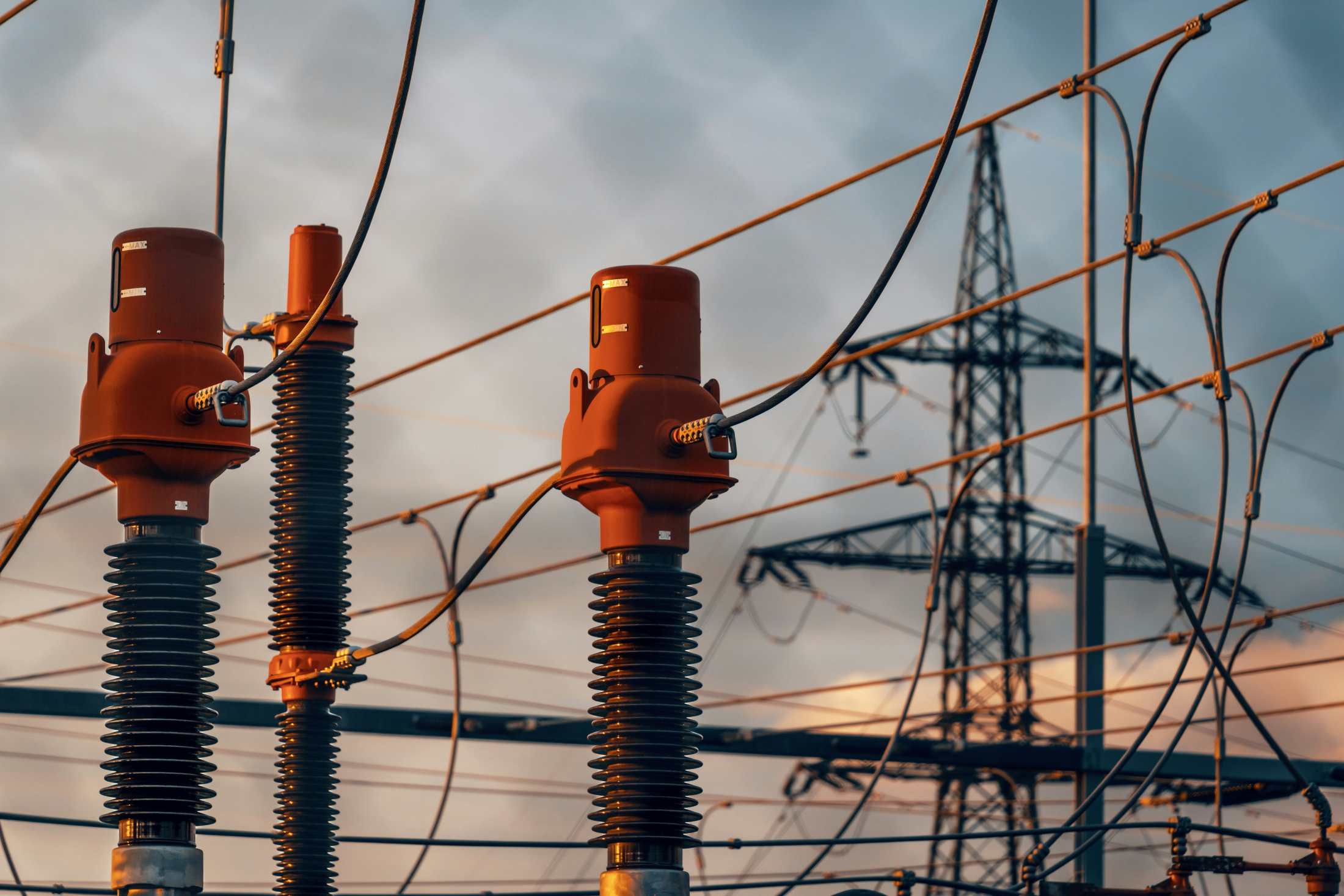
Across the U.S., utilities are waiting for transformers with lead times for some units reaching three years or more. Now, there’s a risk that a new presidential order could stretch out the wait even longer.
President Trump signed an executive order Aug. 26 aimed at foreign-made electrical grid components over concerns some could contain digital backdoors. Electricity demand is rising with the artificial intelligence data center boom. Reviewing equipment for foreign control may be sound security policy, but it could slow the buildout that the order itself cites as a reason for urgency.
The order creates a conditional prohibition on certain transactions but leaves key questions unanswered about which companies, products and projects will ultimately be affected. It’s another example of how policies aimed at national security or onshoring of critical components are likely to run into the reality of the global supply chain. The Andersen Institute wrote about the limits of strategic decoupling in a recent white paper, Chips & Tokens at the Fault Lines. That paper argues that the United States and China each control inputs the other cannot quickly replace, which constrains how far either can decouple.
Wood Mackenzie, the energy analytics firm, estimated that in 2025 imports supplied roughly 80 percent of U.S. power transformers. The import dependence is not entirely made up of Chinese components, and many suppliers are U.S. allies. China accounted for 69 percent of the value of U.S. imports of finished lithium-ion batteries in 2024, in a category that spans vehicles, electronics and grid storage. Critical infrastructure will keep some globally sourced components for years to come, so the real question about the order is which suppliers it will affect.
The AI buildout sharpens that tension. Wood Mackenzie projects that U.S. data center capacity will grow from about 24 gigawatts in 2026 to 110 gigawatts in 2030, or about 95 gigawatts if current bottlenecks persist.
Issued under emergency economic powers, the order lets the Department of Energy prohibit the acquisition, importation, transfer or installation of certain foreign-made equipment, but only after two findings. First, the equipment, or a key component, software package or service behind it, must come from a “covered foreign entity.” Second, the transaction must pose an undue or unacceptable security risk.
The order does not identify specific countries or companies. Instead, it points to the State Department’s arms-embargo list, which includes China, Russia, Iran and North Korea, and reaches companies owned or controlled by, or “subject to the jurisdiction or direction” of those governments. Covered equipment includes large transformers, breakers, grid inverters, grid-scale batteries and substation control systems, along with their software. Facilities used in local distribution are excluded.
Commerce Department data cited by the Department of Energy found that 82 percent of large power transformers supplied for domestic use in 2019 were imported, but Wood Mackenzie says suppliers in South Korea and Brazil are ramping up for U.S. demand. Neither is on the embargo list, though equipment made there could still be covered if its components or software come from covered entities. Batteries look different. Batteries and inverters, along with the software that runs them, could draw the closest scrutiny. That depends on how the department decides what counts as foreign control and what counts as a security risk. China’s large share of battery imports suggests potential exposure, but the figures here do not show which category will be most affected. The sources cited here do not break down transformer imports by country or ownership.

The order arrives in a tight market. In the second quarter of 2025, Wood Mackenzie found that average delivery times were 128 weeks for power transformers and 143 weeks for generator step-up units. Power transformer unit costs rose 77 percent from 2019 to 2025. Part of the bottleneck is grain-oriented electrical steel, used in most transformer cores, where Cleveland-Cliffs is the only domestic producer.
The order itself links the emergency to data centers. It says the rapid growth of data centers, artificial intelligence, advanced manufacturing and defense production has increased the country’s dependence on reliable electricity and magnified the consequences of an attack or supply disruption. Wood Mackenzie expects data centers to account for 68 percent of U.S. load growth from 2026 through 2030, and about 600 gigawatts of proposed projects in its pipeline are still looking for power, against 183 gigawatts with signed construction or electricity supply agreements with utilities. Demand that large and that fast compresses every stage of the supply chain.
The biggest question around the order may be what counts as a deal being “initiated.” The order applies to transactions begun after Aug. 26 but does not define the term, and it applies notwithstanding earlier contracts. With equipment taking years to arrive, much of what will be delivered soon was ordered long ago, so the definition could decide how much of the pipeline is covered.
The Department of Energy took comments through Oct. 9 and is due to publish any needed implementing rules by Dec. 24. Utilities and developers must plan without knowing how the department will apply its entity and risk tests or which transactions it will restrict. That uncertainty may prove to be the order’s first cost: a grid that already waits years for equipment now has to wonder whether the equipment it has ordered will be allowed to plug in.
Boucher, B., Thomas, D., & Mendrek-Laske, M. (2025, October 15). Mind the gap: Tackling supply-chain challenges in the electric T&D sector. Wood Mackenzie. https://www.woodmac.com/news/opinion/mind-the-gap-tackling-supply-chain-challenges-in-the-electric-td-sector/
Havlin, M. A. (2025, November 26). Advanced lithium-ion energy storage battery manufacturing in the United States (CRS Report No. R48538). Congressional Research Service. https://www.congress.gov/crs-product/R48538
Mayer Brown. (2026, September 18). Department of Energy issues request for information with a deadline of October 9, 2026 as first step of rulemaking process for restrictions on foreign-sourced bulk power equipment. https://www.mayerbrown.com/en/insights/publications/2026/09/department-of-energy-issues-request-for-information-with-a-deadline-of-october-9-2026-as-first-step-of-rulemaking-process-for-restrictions-on-foreign-sourced-bulk-power-equipment
Natalucci, F., & Rebucci, A. (2026, June 9). Chips & tokens at the fault lines: Two stacks in one fragmenting world. Andersen Institute for Finance and Economics. https://anderseninstitute.org/chips-tokens-geoeconomic-fragmentation/
Shpitsberg, A. (2026, March 18). Powering the next economy: Investment surge or cost surge? Wood Mackenzie. https://www.woodmac.com/news/opinion/powering-the-next-economy-investment-surge-or-cost-surge/
SteelOrbis. (2026, July). Cleveland-Cliffs wins US defense contract worth $400 million. SteelOrbis. https://www.steelorbis.com/steel-news/latest-news/cleveland-cliffswins-us-defense-contractworth400-million-1462295.htm
Thomas, D., Boucher, B., & Mendrek-Laske, M. (2025, August 13). Transformer troubles: Manufacturing and policy constraints hit US transformer supply. Wood Mackenzie. https://www.woodmac.com/news/opinion/transformer-troubles-manufacturing-and-policy-constraints-hit-us-transformer-supply/
U.S. Department of Energy. (2024, July). Large power transformer resilience: Report to Congress. https://www.energy.gov/sites/default/files/2024-10/EXEC-2022-001242%20-%20Large%20Power%20Transformer%20Resilience%20Report%20signed%20by%20Secretary%20Granholm%20on%207-10-24.pdf
Wood Mackenzie. (2026, April 28). US data center electrical equipment market surges to $65B, reshaping industry dynamics [Press release]. https://www.woodmac.com/press-releases/data-center-demand-drives-us-electrical-equipment-market-to-$65b-reshaping-industry-dynamics/
Exec. Order No. 14,421, 91 Fed. Reg. 55995 (Aug. 31, 2026). https://www.federalregister.gov/documents/2026/08/31/2026-17843/declaring-a-national-emergency-to-secure-the-united-states-bulk-power-system
22 C.F.R. § 126.1 (2026). https://www.ecfr.gov/current/title-22/section-126.1


