

The market remains jittery on the AI trade – Google shed nearly $500 billion in market value and Amazon tumbled on negative free cash flow and higher-than-expected AI investments. This week, though, the IPO everyone’s been waiting for gave investors something to feel good about.
After months of delays, speculation and leaks, artificial intelligence company Anthropic PBC publicly filed its S-1 with the U.S. Securities and Exchange Commission, paving the way for a blockbuster public offering next month.
Financial markets and commentators were quick to parse through the nearly 240,000-word document, looking for any inkling that the company keeping the AI flywheel spinning was simply a mirage of circular deals and accounting tricks. But to the chagrin of permabears, Anthropic’s numbers were nothing short of staggering for a firm that’s only five years old.
The company behind Claude posted year-over-year revenue growth of 1,300% in the first half of 2026, to $16.3 billion, with revenue per employee over $6.6 million, higher than every Magnificent Seven company except Nvidia. Crucially, the sales were more broad-based than investors had apparently realized. The number of customers paying Anthropic more than $100,000 a year surged from 950 to about 11,900 in the twelve months leading up to September 2026.
Above all, existing accounts aren’t just staying; they’re spending more. The S-1 revealed net revenue retention of about 900%, meaning the average customer is paying about 9 times what it did a year ago.
Under the hood, however, there is a concentration risk that investors should keep in mind. The company’s top five customers accounted for roughly 25% of its revenue in the nine months leading up to September 2026.
Of greater importance, these clients don’t have to stick around. “Many of our top customers are not subject to long-term contracts with us…and are able to reduce or in some cases cease spending at any time and for any reason,” the S-1 notes. As competition for cheaper and more efficient models continues, Anthropic is left exposed to a potentially flighty customer base that it desperately needs to fund its ballooning commitments.
Profitability offers a more mixed picture. Anthropic reported adjusted net income of $2.7 billion, a performance that was cheered by investors. But as Jonathan Weil at the Wall Street Journal points out, these results speak to the circularity of the AI financial cycle.
On a GAAP basis, Anthropic posted an $80.7 billion loss. What accounts for the difference? Adjusted net income strips out several items, including changes in the fair value of convertible notes, derivative liabilities and SAFEs. These items come to about $72 billion, driven, the company said, “primarily…by an increase in the fair value of our outstanding convertible promissory notes resulting from an increase in our enterprise valuation.”
Why does that matter? The more Anthropic goes up in value, the larger its paper losses on these liabilities. On the other side of this trade sit its backers, including names like Amazon and Alphabet, who record a corresponding gain in their financials. That means a sizable share of Big Tech’s earnings now depends on Anthropic’s valuation. If it falters after the IPO, those gains could quickly reverse.
Lots has been said about the risks Anthropic has emphasized. The document doesn’t sugarcoat what’s at stake, cautioning that the training of advanced AI systems without oversight could “pose catastrophic or existential risks to humanity.” But before we all die, immediate concerns for investors lie in the nearly 100 pages dedicated to risk factors.
Amid this week’s announcement of several financing deals, investors are increasingly focused on spending commitments that have yet to hit the income statement. This is why Anthropic’s IPO is so crucial to raise capital after various rounds of private financing. Something to the tune of $800 billion, Anthropic has mostly locked itself into future compute commitments that require the flywheel (or hype-cycle) to keep running. Any slowdown in adoption rates or users’ willingness to pay premium prices could leave the company paying for capacity it no longer needs. And according to PitchBook, most of those bills are owed no matter what.

Another risk is related to product liability. While most of the public discussion focuses on AI regulation, Anthropic may be held legally accountable for creating and releasing dangerous, unvetted or defective products, a vulnerability that could affect its bottom line. The firm specifically calls this out, noting, “We may be exposed to liability, litigation, and regulatory action arising from harms associated with our AI models, and our contractual protections and insurance may be insufficient.”
Lastly, investors should be aware of the unique governance structure of Anthropic, and what this means for control when buying into the IPO.
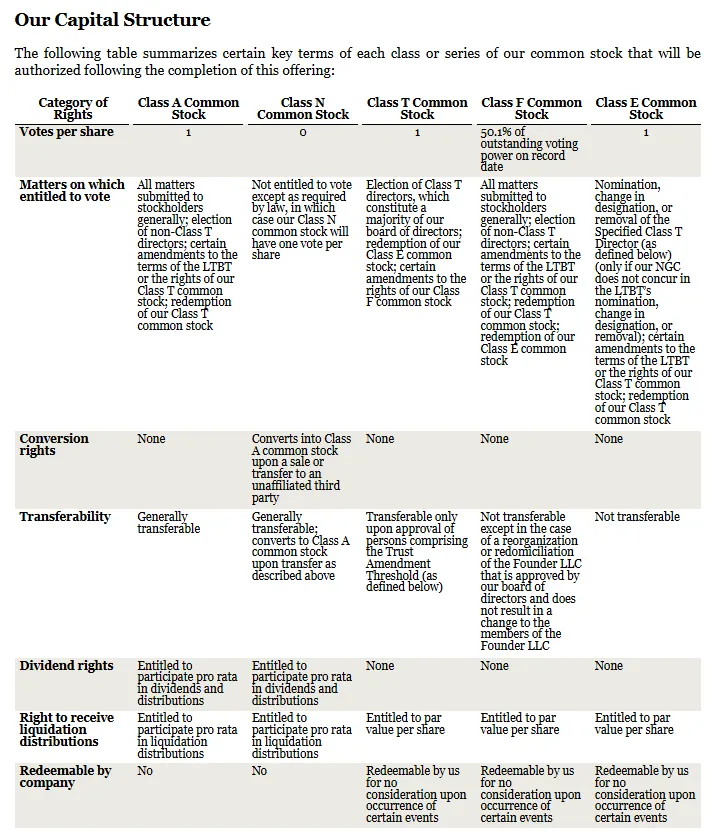
The founders maintain control, not uncommon in the technology industry, e.g., Meta or Google. What’s different is the convoluted machinery Anthropic – or its lawyers – engineered to keep the mission untangled from shareholder pressures.
Anthropic will issue a single share of Class F common stock to the seven co-founders. They will be entitled “to an aggregate number of votes that equals 50.1% of the total voting power of [their] outstanding shares of capital stock.”
Investors will have access through the IPO to shares of Class A common stock entitled to one vote per share. These shares confer economic rights (e.g., dividends) but effectively no meaningful voting control or governance influence.
After this week’s rout in the tech-heavy Nasdaq-100 index on capex spending fears and gargantuan equity and debt financing needs, bubble watchers will continue to look for cracks in the AI trade. The good news is that one of the two most-anticipated IPOs has largely lived up to the hype, with strong revenues and a growing customer base. Whether this continues is anyone’s guess, but the floor isn’t about to fall out from under us tomorrow, or at least until OpenAI’s S-1 is revealed.
To receive more newsletters from Fabio directly to your inbox, subscribe on substack.