During the winter of 2022-23, pediatric amoxicillin was difficult to obtain in many European countries. The European Medicines Agency (EMA) pointed to a combination of increased respiratory infections, production delays, and production capacity limitations in its monitoring of the shortages at the time. When demand spiked, capacity could not be expanded quickly enough to meet it.
Generic medicines such as amoxicillin are largely procured on the basis of unit price. A tender that rewards only unit price does not explicitly purchase the ability to deliver additional supply during a surge, giving manufacturers less incentive to maintain spare capacity.
Supply concentration adds a separate risk. Reuters, citing Eurostat data, reported China’s share of European Union imports of penicillins and their derivatives, rose from 44% in 2019 to 86% in 2025, much of it as bulk active pharmaceutical ingredient (API).
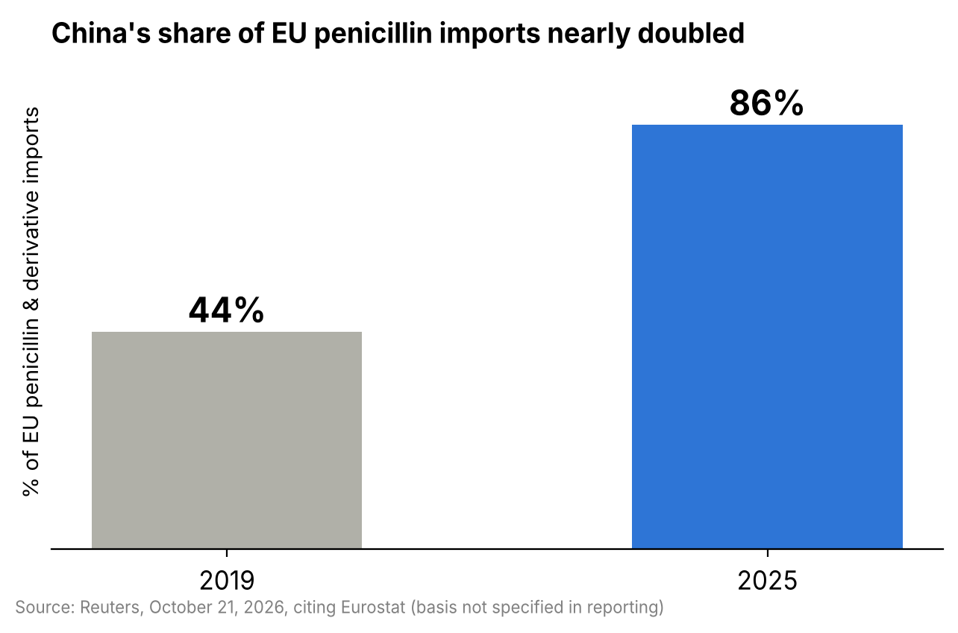
Figure: China’s share of EU imports of penicillins and their derivatives rose from 44% in 2019 to 86% in 2025. Source: Reuters, October 21, 2026.
Sandoz operates the Kundl plant in Austria, which Reuters describes as Europe’s last fully integrated penicillin plant. In written evidence published in June 2026 by the House of Lords National Resilience Committee, Sandoz said Kundl’s capacity to supply Europe was “not commercially sustainable” unless governments paid more for penicillin. In late May 2026, Sandoz filed a draft anti-dumping complaint with the European Commission concerning Chinese imports of amoxicillin API. As of October 21, 2026, the Commission had not opened a formal investigation.
The Kundl plant is still operating, so Europe retains one fully integrated domestic source. The question is how much independent production capacity Europe could rely on if Chinese supply were disrupted, and how quickly. European policymakers increasingly view foreign dependency on critical drugs as a matter of security, not just a market inefficiency that needs to be priced right.
Other markets use different tools to maintain preparedness: gas storage builds inventory, electricity capacity mechanisms purchase availability, and EU FAB reserves vaccine manufacturing capability. Each also shows the limits of its tool. (EU FAB is sponsored by the Health Emergency Preparedness and Response Authority to secure vaccine manufacturing capability across Europe.)
After the 2022 energy crisis, the EU required member states to fill gas storage to 90 percent of capacity before winter. The rule has been extended to 2027 with added flexibility on timing and, under adverse market conditions, on the target itself. The mandate works for seasonal swings. Diversifying away from Russian gas took a separate set of policies. A stockpile of antibiotics made entirely from Chinese API could buy time during a disruption, but replenishment would remain dependent on the same source country.
Several European electricity markets pay power plants for being available, not only for the power they produce, on the view that energy-market revenues alone undercompensate capacity that is rarely used. The relevance to a drug factory depends on exactly what needs to be on standby.
Through EU FAB, the EU pays vaccine manufacturers to keep production capacity ready. Vaccine supply is contracted separately before manufacturing is activated. The logic is that manufacturing capability has value even when it is not being used. Whether an analogous system for antibiotics would also reduce dependence on China is a separate question. A reserved European production line for finished doses that still relies on Chinese APIs would remain dependent on China for critical inputs.
EU FAB is also designed for acute public health emergencies, whereas antibiotic shortages are typically recurring and persistent supply-chain problems.
Of these examples, EU FAB is the closest institutional match for antibiotics. That is not because vaccine emergencies resemble antibiotic shortages, but because EU FAB already buys manufacturing readiness within the EU’s health-preparedness system. An antibiotic version could reduce dependence on a single country only if the reserved capability remained usable when that country’s supply was disrupted, which means securing the active ingredient as well as finished-dose production.
In May 2026, the European Council and the European Parliament reached provisional agreement on the Critical Medicines Act, which would require procurement to consider resilience as well as price. Since October 2023, EMA’s medicine shortages steering group has run a voluntary solidarity mechanism through which a member state facing a critical shortage can ask others for stock. Member states activated it seven times in 2024, all for oncology medicines and none for antibiotics. The European Commission’s Health and Digital Executive Agency (HaDEA) has run a tender for a pilot on long-term API stockpiling and rapid finished-dose manufacture (bids closed in September 2026), and in July 2026 it opened a tender for an EU FAB-style pilot reserving manufacturing capacity for nitrile gloves and FFP2 masks.
The provisionally agreed Critical Medicines Act would change procurement rules, while the solidarity mechanism redistributes existing stock. Those pilots explore relevant preparedness tools, but do not by themselves establish that Europe has an antibiotic supply option independent of Chinese inputs. Stockpiles can bridge demand surges and temporary interruptions, but they do not by themselves create an alternative source of replenishment.
The comparisons above support extending EU FAB-style readiness payments to selected antibiotics, alongside inventories and procurement reform. To address dependence on China, the reserved capability would need to remain usable when Chinese inputs were disrupted, with clear rules for activating production and delivering medicines.
Source: Reuters, “How cheap Chinese antibiotics threaten Europe’s last major penicillin plant,” October 21, 2026, citing Eurostat. Additional claims draw on EMA’s shortage monitoring materials and the MSSG 2024 annual activity report, HaDEA’s tender notices, and Reuters’s reporting on Sandoz’s written evidence to Parliament and its anti-dumping complaint.